


Uncle Phil
by Paul Wrubel via Room 72

Camp Winnebago, Bunk 1, 1947
The illustration for this piece has a past. It is a picture courtesy of a Maine historical society of the crew from Bunk One at Camp Winnebago. The year is 1947 and the kid second from the left in the front row is me at 7 years of age and the blond camper next to me is Paul Schwarz, my oldest and dearest friend then and still is to this very day. I remember the others as well but the one I want to mention is the boy on the left directly behind me in the back row. His name is Phil Lilienthal.
Phil’s father, Howard Lilienthal, was for all intents and purposes the camp director at the time and later the owner of Camp Winnebago. He ran a good ship and over the decades gave hundreds of boys a leg up on life. As the years passed, we loved playing tricks on Uncle Howie (all counselors and administrators were called “Uncle” at camp Winnebago). My personal favorite occurred on his 6oth birthday which fell during the winter and was celebrated at Lüchow’s Restaurant in New York City. By then we were full-fledged adults in terms of age but we had never really grown up when anything about camp was involved. Our birthday gift to Uncle Howie reflected that deep sense of arrested development.
The day before the party, Howard’s younger son, Bob picked up Paul Schwarz and me in his truck and headed north to camp of course. One of the older traditions at Camp Winnebago was stealing the very large sign for Camp Vega, a girls’ camp, one of two other camps that shared the shores of Echo Lake with Camp Winnebago. We decided to give Uncle Howie a special present. We stole the Vega sign in the dead of winter and drove it a few hundred miles to a parking spot a couple of blocks from Lüchows in New York City. At the appropriate hour two Pauls and Bob lugged the very heavy and unwieldy sign down a New York City sidewalk past curious New York gawkers and delivered the goods to Uncle Howie. After the thrill had died down a bit and after the party had begun to break up, the three of us packed up the Vega sign and returned it to its proper place at the entrance of a very cold and desolate Camp Vega in the fading hours of a blustery Maine winter day. It was a round trip of about 8-10 hours depending upon how much time we spent devouring a lobster at the first pit stop on the Maine side of the border with New Hampshire.
But this story is not about Howard. It is about his son, Phil. After high school Phil went to Amherst and then on to other things including the University of Virginia Law School but he never left Winnebago. He married his “childhood” love of his life, Lynn, and did a stint in the Peace Corps in Africa. Later on, after Howard retired, he became the Director and Owner of Camp Winnebago and ran the place for several years. Paul Schwarz also returned to serve as the camp’s best all-time head counselor until his retirement a few years ago. Phil turned over the camp operation to his son, Andy, who manages the camp to this day. Camp Winnebago enjoys an extraordinary and well-deserved reputation largely as a direct outcome of the creative and enlightened leadership of three generations of Lilienthals. The tale of Uncle Phil doesn’t end here.
Phil Lilienthal could have easily faded into a life of comfort and considerable wealth but he chose to do something more, something better, something unfinished that began during his Peace Corps years.
Phil founded and is the President of “…Global Camps Africa, a non-profit whose mission is to empower children for an AIDS-free tomorrow. These children are affected by many kinds of violence and have been affected by the HIV crisis in (South Africa’s) Soweto Township. Phil’s 8-day camps and the follow-up biweekly sessions provide a way for the children to see hope for the future.”
“…In 2004 Phil opened Camp Sizanani which is the Zulu word for “helping one another”. To date 5000 children have attended the camp. The staff members are trained locals and many of the volunteers come from Northern Virginia.” Here is “…how Phil described life at the camp.”
“Arriving on the first day of camp, the campers look like children without a care in the world. As the life skills classes move through the various phases of the curriculum, the stories come out of abuse, beatings, rape, incest, and deprivation. Many have to be educated as to what “abuse” is. They don’t know it as anything but the norm, as the condition we describe as “abusive” is one that they have been living with all their lives, including physical, psychological and sexual abuse. Educating children that this is not the norm can change not only the children at camp, but those siblings and friends they interact with after camp.”
Phil continued, “The epiphany that came to me during the January camp (summer in the southern hemisphere) was that the strength we are giving the campers is in the form of transformation. We are not changing the circumstances of their lives; we are, rather, giving them the tools to see their lives as possibilities for excellence despite their current circumstances.”
The above quotes were taken from an article written by Kelly Reid of the Peace Corps Association. It was part of an announcement that Phil Lilienthal, “Uncle Phil”, my friend and former bunk mate, will be the recipient of 2013 Sargent Shriver Award for Distinguished Humanitarian Service. “Named to recognize the first Peace Corps Director – Sargent Shriver – whose efforts resulted in outstanding contributions to the founding and development of the Peace Corps, the National Peace Corps Association annually awards the Sargent Shriver Award for Distinguished Humanitarian Service to a Returned Peace Corps Volunteer who continues to make a sustained and distinguished contribution, whether that be a humanitarian cause at home, abroad, or through innovative social entrepreneurial efforts to bring about significant, long-term change. Each year, the recipient of this prestigious award is honored for their incessant devotion to bettering the lives of those not only around them locally or nationally, but across the globe.”
In these times of cynicism and political incivility it is nice to know that special people like Phil Lilienthal still walk this planet. He and the kids he helps make us all better human beings.
Note: If you would like to support Phil’s work you are encouraged to send a check to:
Global Camps Africa
1606 Washington Plaza
Reston VA 20190
Just so you know…
$1,000 will send a child to one residential camp, enable the camper to attend the year-round Youth Clubs, and buy supplies for a cabin of 15 campers.
$500 will send a child to camp and enable the camper to attend Youth Clubs for a year.
$250 will purchase arts and crafts supplies for $140 children attending a camp session.
$100 will purchase shoes for a cabin of 12 children.
$50 will purchase new t-shirts for a cabin of 10 children.
Thanks.
Follow Paul Wrubel's blog, Room 72, at www.paulwrubel.com.
GCA Founder & President Wins 2013 Sargent Shriver Award for Distinguished Humanitarian Service
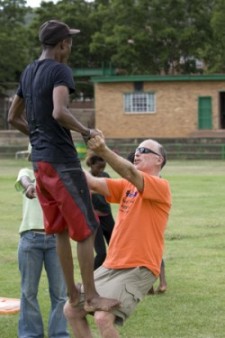
On June 4th, the National Peace Corps Association announced the winner of this year's Sargent Shriver Award for Distinguished Humanitarian Service, which recognizes a Returned Peace Corps Volunteer who "continues to make a sustained and distinguished contribution, whether that be to humanitarian causes at home, abroad, or through innovative social entrepreneurial efforts to bring about significant, long term-change."
The 2013 winner of this national honor is our own Phil Lilienthal, Founder and President of Global Camps Africa.
The award will be presented at this year's Peace Corps Connect in Boston, MA, on June 29th. Congratulations, Phil, on this well-deserved honor!
To read more about the award, Phil's achievements, and other Sargent Shriver award winners, please visit the National Peace Corps Association's web site.

30,000 of Our Closest Friends

AIDS Walk NYC 2013
By Guest Blogger Brian C.
Those scheduled to attend might have looked out their windows to see the pouring rain under dark clouds in a Sunday morning sky and thought, "I already made my donation...I think I'll stay in." I know the thought crossed my mind. A 10-kilometer walk in the best of circumstances is daunting. And AIDS Walk NYC 2013 was a charity event so concentrated on single-day performance that the city's awful forecast loomed as a serious threat to its success. For many scheduled to attend, curling up on a dry sofa with a good book probably seemed like a welcome alternative to braving the nasty.
But so, Global Camps Africa (GCA), along with its donors, sponsors, families and over 30,000 of our closest friends proudly gathered in New York City under Central Park's dripping spring canopy. GCA was one of hundreds of teams there, where each had arrived to represent its piece of a vital international HIV/AIDS relief effort.
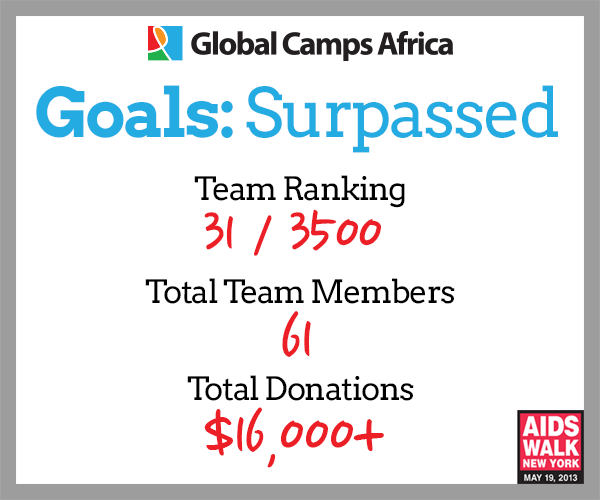
Global Camps Africa was, in many ways, leading Sunday's charge. Its team started preparing for the event over a month ago with a few specific goals: Let's register 50 team members, and let's raise $10,000. They did that, and more.

I was there to witness this. My wife, Emily, and I drove to the city, and we brought our 3-year-old son. He jumped into my backpack, ready to go for a ride. But it was all a first for me. I had never before taken the AIDS Walk – not in NYC, not in SF, or any of the other prominent cities where the event is held. It was completely new, and seeing such a mass of humanity join together in purpose was flatly overwhelming. See, I may not have the opportunity to directly impact the children that GCA aims to empower. I may not find myself in the position to become a vocelli, or visit Camp Sizanani in South Africa. It just may not be in the cards. But an event like this gives us a rare opportunity to tap into a palpable sense of community – it feels like the highest potential of a life. I'd recommend it and anything like it. I would recommend that you squeeze your loved one, make your donation, and go for your walk. Brave whatever weather comes your way. I, for one, will do this again.
Jewelry Artist Supports GCA Through Her Work
After studying fine art at the Corcoran School of Art, Martha Lytton Van Trees now crafts beautiful and unique jewelry of copper and silver. She says of her art, “I make out-of-the-ordinary modern jewelry for the out-of-the-ordinary modern woman or man.” Martha calls her line of jewelry “Urban Jule” defining “jule” as quirky, someone who does things out of the ordinary, a hot girl with bold looks.
Martha sells her handcrafted designs on Etsy and at Northern Virginia markets and craft fairs, including the Lake Anne Saturday Farmers Market near the Global Camps Africa office in Reston. She has committed to donate a percentage of the sale of all earrings to GCA.
“I was invited to the Global Camps Africa fundraising event,” she said, “and was blown away when I heard about the work you’re doing in South Africa. I want to contribute what I can to be part of that.”
Martha’s Etsy shop can be found at http://www.etsy.com/shop/UrbanJule. Coming soon...check out her new line of African inspired earrings!
U.K. Ends Aid to South Africa
It sounds like bad news, right? But the British government explains its decision to stop sending aid to South Africa as a vote of confidence in the emerging African economy. $29.5 million in planned financial support will not flow from the U.K. to South Africa in 2015, because, according to the British International Development Secretary, South Africa can afford to pay its own development bills.
In the country with the highest number of HIV-infected people in the world, the cost to the government of providing healthcare and other needed social services is high. Though the British aid being terminated constitues only a small part of South Africa's annual budget, one wonders what the impact of decreasing financial resources might be on these individuals - many of whom are already living on the margins.
Is cutting aid to South Africa another route to empowering South Africans? Or is it a dangerous decision that may jeopardize the tenuous progress being made there in the fight against HIV?
To read more about the U.K.'s decision, click here.